Cheerleading judging: how to keep one standard across judging panels at big events
Cheerleading judging rests on one idea: a team should receive the same score no matter which floor it performs on and which panel watches it. At a small festival this often happens on its own. At a national event, with many teams and several panels working in parallel, one common standard has to be held on purpose.
JESYS is electronic judging software. Cheerleading events run on it, including with the Cheerleading Federation of Russia. We are not a federation and not a government service. Rules, criteria and formulas come from the organizer's regulations, and judges set the scores. Below is what makes cheerleading judging different, and what JESYS does so that panels stay consistent.
 National Cheerleading Championships, Moscow: the panel scores a routine from laptops beside the floor.
What makes cheerleading judging special
Many divisions and categories. Stunts, cheer dance show, hip-hop, groups and doubles. Inside each one there are age groups and levels. For the Cheerleading Federation of Russia, JESYS holds one registry of criteria for several dozen judged divisions, and each division has its own rules.
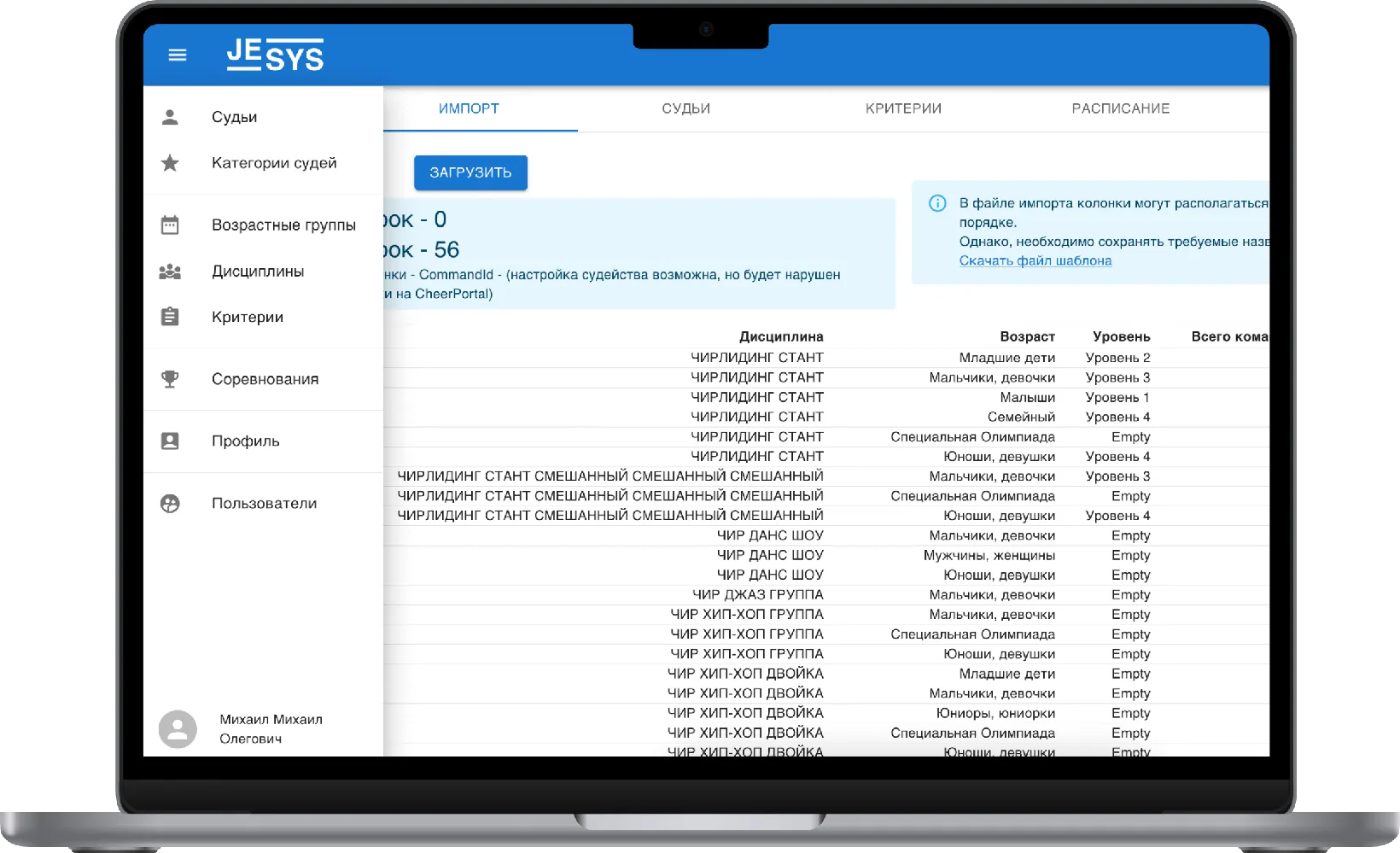 Divisions of a national event in JESYS are all loaded instantly from one file in a special format.
Several judging panels. When there are many teams, the organizer opens parallel floors or splits the day into blocks. Each floor has its own panel. A team in a category may meet one panel in the morning, and its rival another panel after lunch.
A fast flow. Routines follow one another. A judge has only minutes between them. If those minutes go to adding points on a calculator, less attention is left for the routine.
Different roles on the panel. Some judges score execution and difficulty. Others handle deductions and violations. A team's result comes from several people.
How the result is calculated
In cheerleading, a team's result is not one number from one judge. It is usually several judges' scores on each criterion, plus deductions, plus a formula that turns this into points and a place. The formula depends on the regulations: a sum in one place, an average in another, dropped extreme scores in a third.
On paper, the secretary builds this summary. They collect the sheets, copy the points into Excel, check the formulas and only then announce places. Every copy is a chance for a typo.
In JESYS the summary happens as the score is entered. The judge puts points on their sheet. The software applies the formula from the regulations, includes deductions and recalculates places in the category. The secretary checks the protocol and exports it to PDF or Excel.
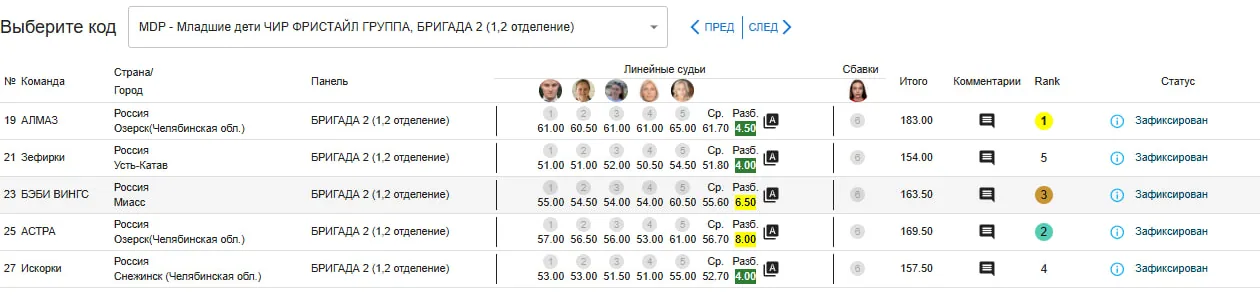 Every judge's scores, deductions and the total in one table. Nobody has to add it up by hand.
The hard part of a big event: panels drift apart
Each judge relies on their own experience. Inside one panel, judges gradually align with each other. Two panels that do not see each other all day can drift: one scores a little higher on average, the other a little lower. For teams, that is already about places.
The same judge's morning and evening scores can drift too. Without a report for the day, the organizer will not see it.
Coaches notice. After awards the question is: "Why were we judged stricter than the team on the next floor?" Without data, the organizer has nothing to answer with.
What JESYS does to keep panels consistent
One set of rules for every panel. Criteria, formulas and judge roles are entered once. Every panel works in the same sheets and under the same rules. For the Cheerleading Federation of Russia we built one judge registry and one criteria registry for several dozen judged divisions.
Recommended and target score levels. JESYS can calculate minimum and recommended score levels from algorithms agreed with the organizer. The judge sees a reference point. The organizer sees where scores moved far from it. This is not a hint of which score to give. It is a shared reference for every panel. In the federation project, score recommendations and reports of deviation from target scores were set up by division.
Deviation reports. The organizer and the head judge see where a judge's scores differ clearly from the target or from colleagues. They can review those routines, not the whole protocol.
Shadow judging. Shadow shows where scores diverged, how a judge's accuracy changes through the day, and on which criteria they are stricter or kinder than colleagues. More in Shadow judging.
Changes during the day. A team is moved to another category, or two small divisions are merged. The secretary makes the edit, and JESYS recalculates places and protocols. The panels keep judging.
Access by role. A judge sees their own sheet. The secretary runs lists and protocols and does not change scores. The head judge and the organizer see every panel. For the federation this is one place to manage scores, with different levels of access.
Decisions stay with people. JESYS does not change scores on its own and does not punish judges. It shows where panels diverged. The head judge and the organizer decide what to do.
What the organizer gets
The organizer sets the regulations once and sees every panel in one system. Places in a category recalculate themselves, and protocols export to PDF or Excel. If a coach argues after awards, the organizer opens the deviation report instead of rebuilding the day in a spreadsheet.
In the project with the Cheerleading Federation of Russia, time spent preparing the judging fell by 6 times, and the judging process itself became 3 times faster.
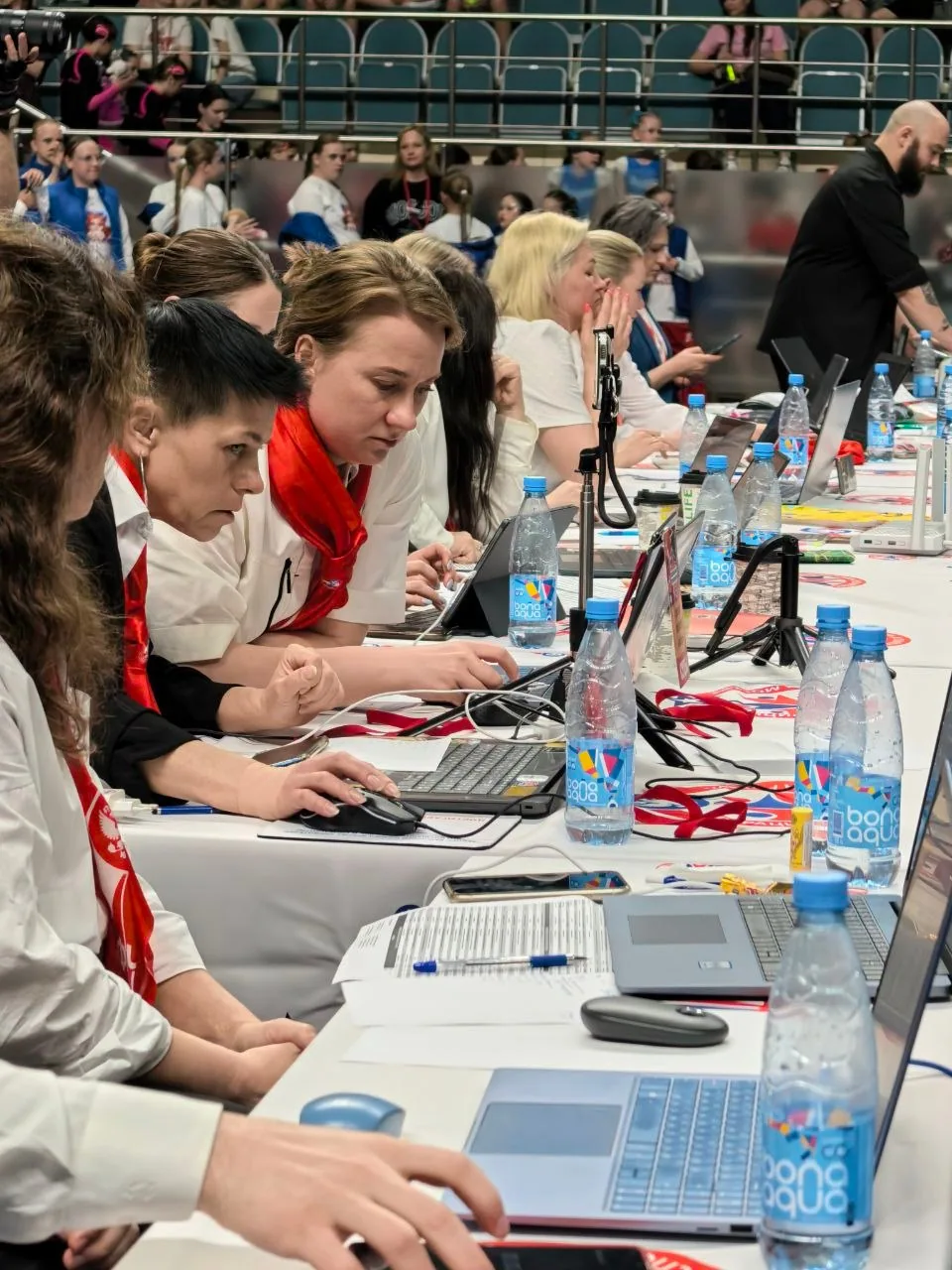 Cheerleading event in Moscow: the panel scores from laptops. Phones on tripods record the routines for later analysis and review.
What judges get
A judge works in their own sheet: criteria from the regulations, points in the cells. The software calculates totals, deductions and place, so the gap between routines is not spent on a calculator. A recommended level is a shared reference for the panels, not an instruction of which score to give. If a score needs an explanation, the judge writes a comment to the athlete on the sheet. An AI assistant suggests wording and helps edit the text. It does not set the score.
At the International Cheerleading Champions League in Kazakhstan, express training of the judging panel on the system took a few hours.
What studios and teams get
A studio wants its team judged on the same standard as its rivals, whatever the floor and the time slot. The coach receives a personal protocol: each judge's score on each criterion, deductions and comments. The conversation about the result is then about numbers.
How the score sheet and the personal protocol work is in Electronic judging. If part of the panel has to score online on the same day, see Mixed judging.
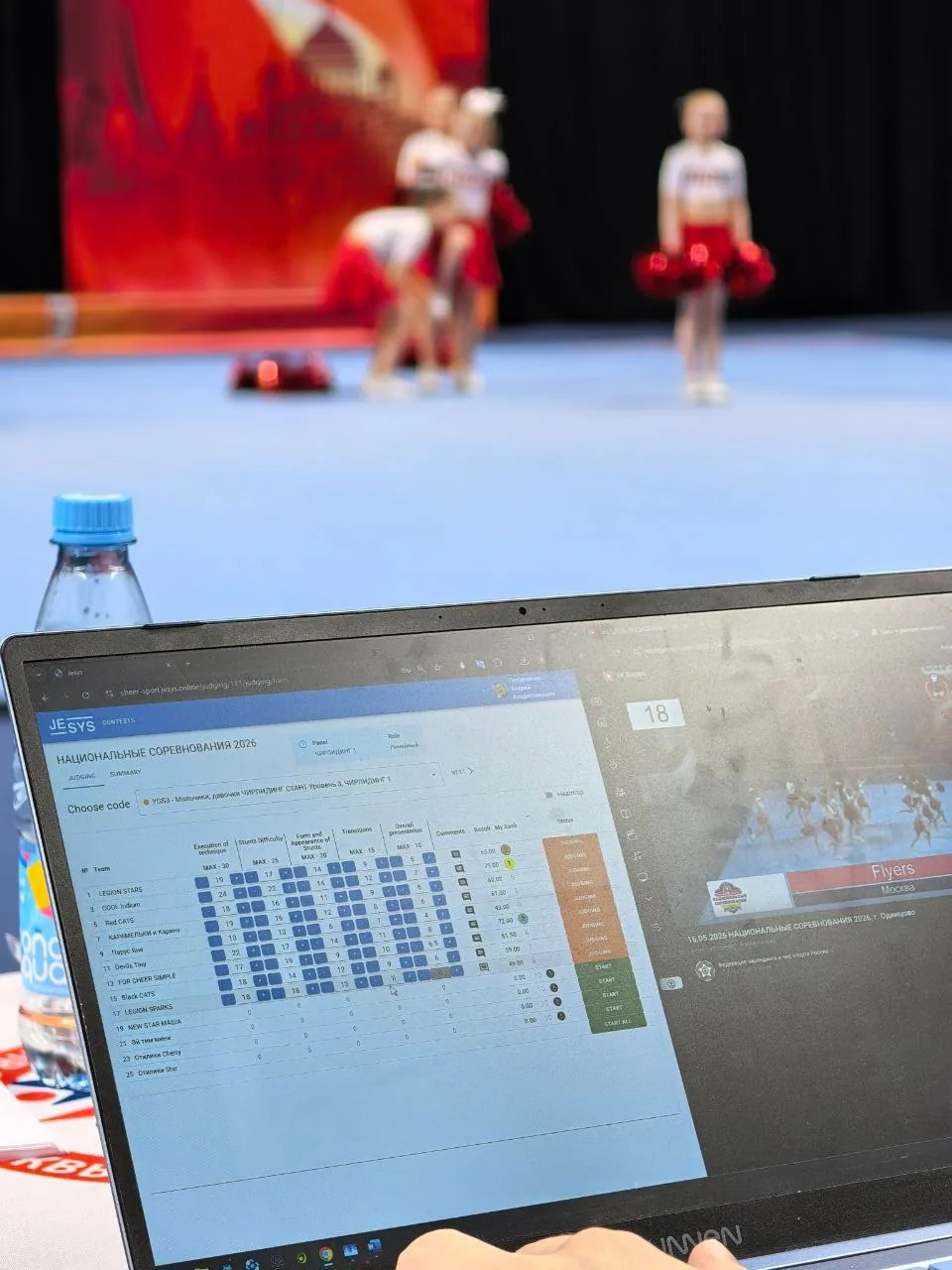 National Championships 2026, Odintsovo, 16 May: a judge scores in JESYS from a laptop beside the floor.
How to start
- Leave a request on the site. We will call and show JESYS on a cheerleading event.
- We go through your regulations: divisions, criteria, formulas, judge roles and the number of panels.
- We set up the system and run a pilot event.
- We train judges and secretaries.
The software does not run the event. Judges set the scores, and the organizer draws the conclusions. JESYS holds one set of rules, calculates the result and shows where the panels diverged.
If you want to talk through your competition, festival or the specifics of your sport, write to us.
Short answers
Who sets the scores in JESYS? The judges. The software applies the formula from the regulations and calculates deductions and places. It does not assign the score itself.
How do you keep one standard across panels? One criteria registry for every panel, recommended and target levels, deviation reports and shadow judging. The head judge decides what to do with that.
Where do the speed figures come from? Preparing judging 6 times faster, and judging itself 3 times faster, is the result of the project with the Cheerleading Federation of Russia. A few hours to train a panel is the International Cheerleading Champions League in Kazakhstan.
