Shadow judging: how an organizer can see the quality of the judging panel
Shadow judging is a second, calm look at how the judging panel scored an event. The organizer opens a report and sees where judges disagreed, where they got tired towards the end of the day, and on which criteria someone is consistently stricter or kinder than the rest of the panel.
In JESYS this is done by Shadow, an analytics layer on top of electronic judging. It is useful for federations and for organizers of tournaments and festivals in cheerleading, dance, aesthetic gymnastics, aerial, pole and other sports where the result comes from several judges' scores. We are not a federation and not a government service. We build the software. The organizer and the head judge draw the conclusions about judges.
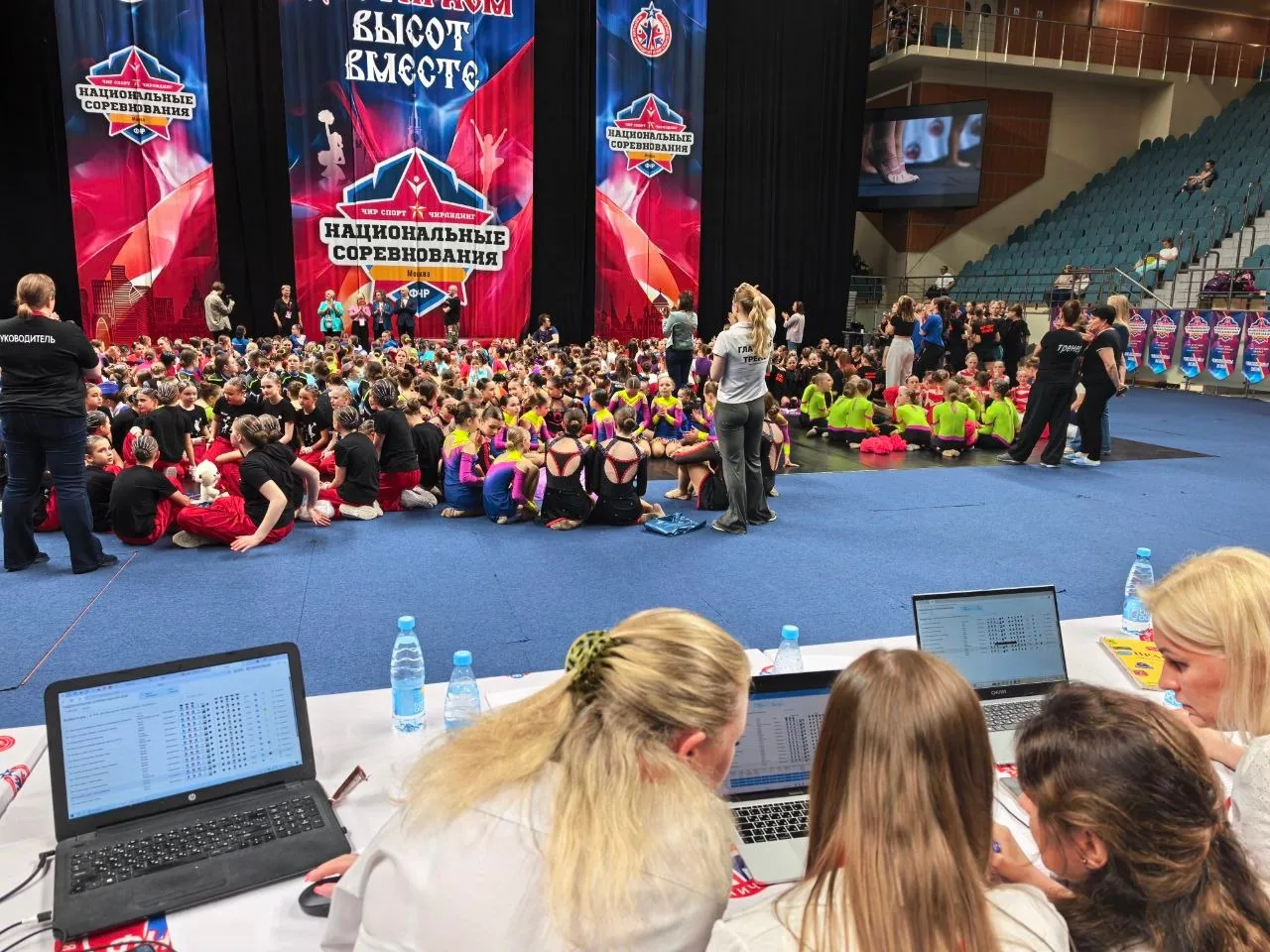 National Cheerleading Championships, Moscow: judges work on laptops beside the floor.
Why an organizer needs shadow judging
The organizer is responsible for results people can trust. After the awards a coach walks up and asks: "Why did we get so little for synchronization?" Without data, the organizer can only shrug or rewatch videos all night.
Shadow gives the organizer something solid for that conversation.
Trust in results. The organizer sees which performances were scored controversially and can check exactly those. There are usually only a few, and the organizer knows them by name.
Talking to coaches. When a coach disputes a score, the organizer opens the report and checks whether the panel disagreed on that performance. The argument moves from emotions to numbers.
Training the panel. The head judge sees on which criteria a judge should sharpen their eye. It is material for a debrief after the event, not a reason to punish anyone.
Systematic strictness or kindness. One judge may score a little higher than colleagues every time, another a little lower. One performance won't show it. A whole day shows it at once.
Regular quality checks of judging are normal practice, like a coach reviewing a game. Shadow makes them quick: nobody has to collect scores from paper sheets and merge them in Excel.
What the organizer sees on screen
Below are Shadow screens for one judge over a competition day.
Accuracy by criteria
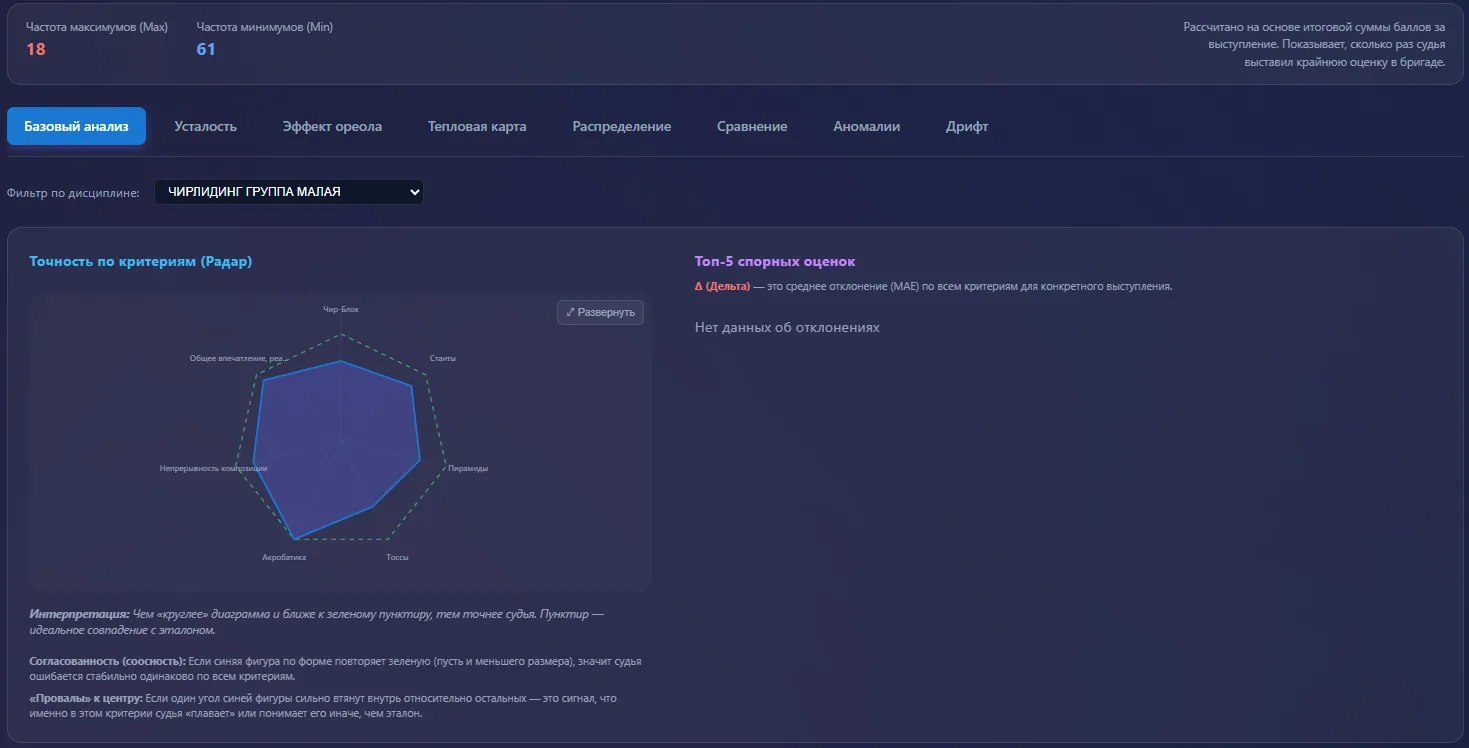 Shadow basic analysis for small-group cheer: the criteria radar on the left, the list of controversial scores on the right.
The radar shows the judge across the discipline at once: cheer block, stunts, pyramids, tosses, acrobatics, continuity of composition, overall impression. The rounder the blue shape and the closer it sits to the green dotted line, the closer the judge is to the panel. If one corner collapses toward the center, the judge reads that criterion differently from the others.
On the right is the list of the most controversial performances. On this slice the list is empty: the filter has no deviations. When there are some, the organizer starts the review there instead of scrolling the whole protocol.
Fatigue towards the end of the day
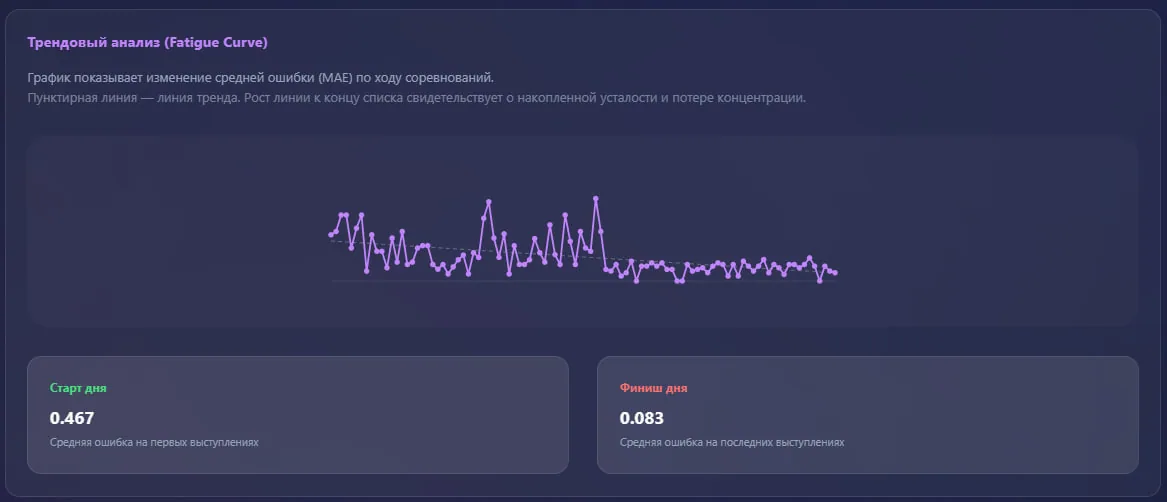 Average error through the day. The dotted line is the trend. Below: error at the start and at the finish.
The chart shows whether the error grows towards the end of the list. A rising line means fatigue. On this screen it goes the other way: the average error is 0.467 at the start of the day and 0.083 on the last performances, and the dotted line slopes down. The judge was more accurate at the finish than at the start. Spikes in the middle of the day mark performances worth rewatching.
If on another event the line clearly rises towards the finish, the organizer can add a break for the panel or plan a judge rotation.
Comparison with the panel
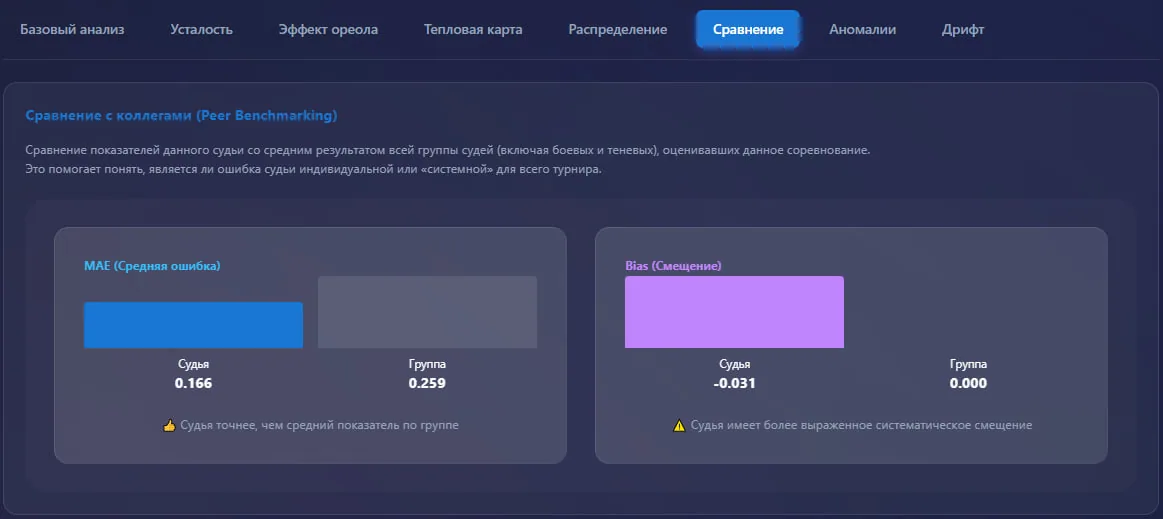 Left: the judge's average error against the group. Right: bias against colleagues.
Here the judge is compared with the average of everyone who scored this event. The judge's average error is 0.166, the group's is 0.259: on accuracy the judge is better than the average. Bias is −0.031 against the group's zero. The shift is small, but the screen flags it as more pronounced than the panel's: the judge sits slightly and systematically below colleagues, rather than missing at random.
How criteria move together
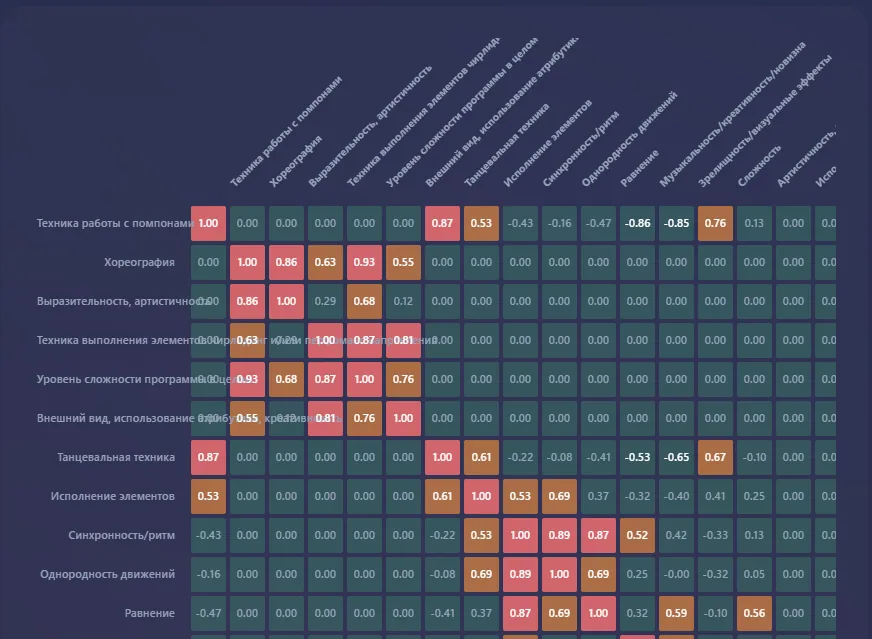 Which criteria judges score "together" and which independently.
This table helps the head judge see whether judges really separate the criteria. For example, if judges almost always score "choreography" and "difficulty level" the same way, they may not tell them apart. Then it is worth clarifying the wording in the rules or going through it at a panel seminar.
Random errors or a systematic tilt
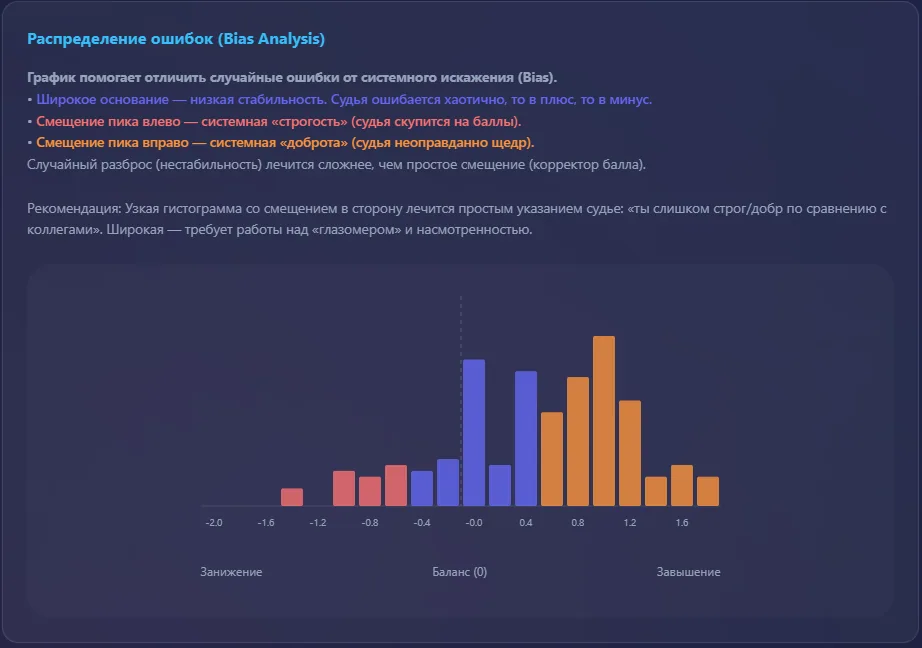 Left: under-scoring. Right: over-scoring. Center: in line with the panel.
The chart answers a simple question: is the judge wrong at random, or do they have a habit? If the bars are spread wide, the judge errs both up and down. If the peak is shifted to one side, the judge is systematically stricter or kinder than colleagues.
A systematic shift is easier to fix: it is enough to tell the judge "you score higher than the panel". A wide spread needs more practice and a trained eye.
Drift on each criterion
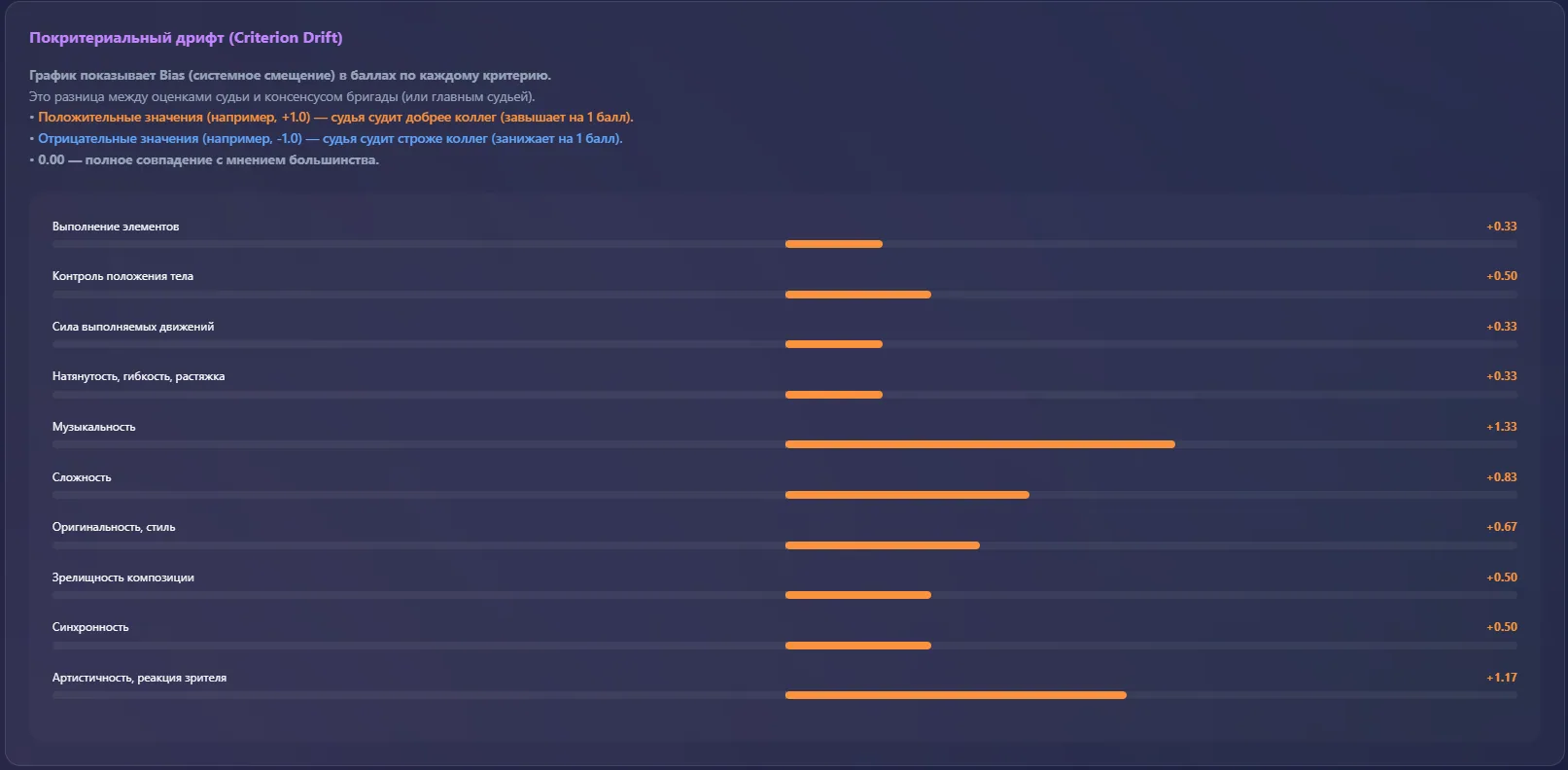 How many points, on average, the judge scores above or below the panel on each criterion.
Here the organizer sees exactly which criteria a judge diverges on. Plus means the judge over-scores, minus means under-scores, zero means full agreement with the panel. On the screen above the judge is noticeably more generous than colleagues on musicality and artistry. That is a concrete topic for the post-event talk.
How shadow judging fits with JESYS
At an event with JESYS, judges score in the software. Every score is already digital: per judge, per criterion, per performance. So Shadow does not ask you to move anything. The organizer does not retype sheets or build Excel tables. The report is built from data JESYS already collected during the event.
You can look at Shadow after the competition, when the day is closed. Or you can open it during the day to catch panel fatigue in time.
People still make the decisions. Shadow does not change scores or recalculate places. It shows the picture. The head judge and the organizer draw the conclusions.
How to start
- Leave a request on the website. We'll call you and show Shadow on an example.
- If you already judge with JESYS, we'll connect Shadow to your events.
- If not yet, we'll start with electronic judging and add the analytics next.
- After the event we'll go through the report together with your head judge.
Want to talk through your competition, festival or the specifics of your sport — write to us.
